MAIN SOURCES

MAIN SOURCES

Saturday, October 25, 2014

Help Your Team Spend Time on the Right Things


What is the most common resource that’s always in short supply? The answer, of course, is time. This applies not only to your time, but to your team’s. It’s the one organizational resource that is neither expandable nor renewable. Therefore, making sure that time is spent in ways that will have the biggest impact is a critical determinant of organizational success.
Unfortunately, many managers don’t think about time as a finite resource in the same way that they consider the limitations of headcount and budget. Therefore they don’t hesitate to give their teams more assignments without taking any away. The consequence of this is that their people work longer hours – and it’s often not clear what’s actually important and what can wait. This cascades through the ranks so that almost everyone feels overstressed and overworked. As one senior executive sadly said to me, “There is no time in the year anymore when things quiet down.”
But steps can be taken by managers to overcome this dynamic and better leverage organizational time. The first is to sharpen their vision of what their unit needs to do better in the next year or two, so that the priorities are clear. The second step is to free up time to move towards that vision by consolidating, eliminating, or streamlining current activities. The third step is to reallocate the newly liberated capacity to short-term experiments that will help them learn how to get to the vision quicker and with greater impact.
Let’s look at the Americas Field Marketing organization for Cisco Systems, as an example of this three-step process. For two years, this nearly 130-person unit had worked hard to drive customer relevance, generate demand, and increase loyalty in partnership with its sales teams across North, South and Central America. They had organized tradeshows, delivered direct marketing, generated leads, and provided useful customer insights – the basics of a successful marketing organization.
During this time, however, Cisco’s customers were beginning to purchase and use technology in new ways. Increasingly, tech-savvy business managers, instead of just IT professionals, were making buying decisions; user-generated applications were being added on top of the basic technology; cloud computing was becoming prominent; and digital media was becoming a key influence in deciding which technologies to purchase. Customers were self-educating and researching buying decisions in new ways – not just with a sales person.
In the face of this new reality, the marketing leadership team realized that many of their traditional face-to-face activities were no longer sufficient. So at an offsite, they began to develop a vision for Marketing 2.0 – with a focus on data analytics, cloud marketing, more targeted use of Cisco.com, 3rd party websites, and social media, and better identification of organizational buyers – all in support of generating better leads (and better tools to build customer relationships) for the Cisco sales teams.
While all of this was very exciting, the reality was that there were no new resources to dedicate to this work. Sales was still dependent on them to do the traditional marketing activities. As a result, the Americas Field Marketing leadership team shaped “capacity creation” projects to get the current work done with fewer resources or less time. This allowed them to redeploy time to new initiatives.
For example, one project was to consolidate similar types of marketing support across several sales groups. Another was to identify low payoff events and stop supporting them. In addition, the marketing team was encouraged to avoid low priority requests from sales. For activities with no demonstrable impact, they were told to answer with a polite “no,” followed by suggestions for more impactful options.
With extra time available, the leadership team commissioned several new pilots that would move the marketing organization towards vision 2.0. To make sure that the pilots wouldn’t become time sinks and would actually get finished, each one was designed to be narrowly focused on a particular aspect of the new vision, involve a limited number of people, and to be completed in 100 days or less. One of these “rapid results” projects was aimed at learning how to take advantage of data analytics. It achieved its goal of integrating digital behavioral data about customers in one country in order to increase their engagement by 20% in 60 days. Another successful project focused on increasing the collaboration between sales and marketing in one market to improve lead conversion rates by 16% in 100 days.
Naturally, this kind of transformation is not a one-time effort, but rather an ongoing process that needs to be continually refreshed and refocused. In the case of the marketing group, the leadership team now considers the portfolio of capacity creation and rapid results projects every quarter, as they move toward their Vision 2.0, so that they can continue to learn, build on what works and what does not, and make adjustments.
There also are skill challenges involved in pulling this off. At Cisco, for example, it became clear that some people did not necessarily have the skills needed for the new kinds of marketing work. So the marketing leadership team had to figure out how to create a more dynamic staffing model for their work through a combination of training, new hires, temporary assignments, and natural attrition.
New initiatives are necessary to move an organization forward. But without a conscious ongoing strategy for managing the time involved, the chances of success may be limited and short-lived.
More blog posts by  and 
Ron Ashkenas HBR

Ron Ashkenas is a managing partner of Schaffer Consulting. He is a co-author of The GE Work-Out and The Boundaryless Organization. His latest book is Simply Effective.
80-Amy_McDougall

Amy McDougall is the Marketing Strategy Lead for the Americas Field Marketing group at Cisco Systems.

A Military Leader’s Approach to Dealing with Complexity


The most effective leaders I’ve known or studied all share a common trait: they were unwilling to settle for the existing state of affairs. They believed with all their heart that what we focus on can become reality.
In my quarter-century of military service, I’ve been afforded the rare privilege of leading in a broad array of environments: commanding a 500-person special operations expeditionary air refueling group in the Middle East after 9/11; guiding a 7,000-person military community through a dramatic mission transformation in North Dakota; and leading men and women from 14 NATO nations in building a sustainable, independent Afghan Air Force in an active war zone—something that had never previously been attempted.
I know how daunting it can be to lead dedicated professionals to undertake complex endeavors, and I’ve lived the reality of trying to bring positive change to large, bureaucratic organizations. Here are four principles I’ve learned that can help you enhance your leadership while concurrently bringing out the best in those around you.
Principle 1: Craft your vision in pencil, not ink.
It is a well-accepted role of leaders to focus on the future and pursue the possibility it holds. In other words, leading entails being a visionary—confidently looking ahead and ascertaining how best to transform your current reality into your desired future. One of the most significant errors I see leaders make is developing their vision in isolation and then expecting people to accept it at face value. When leaders do this, they violate one of the most important truths of promoting change: our words create our worlds. How we choose to describe and discuss what we are doing and where we are going is important, but what moves people to sustainable, self-motivated action is understanding the why behind the vision. That vision can only be fully realized if leaders involve others in the process of creating it.
Ultimately, what makes a vision come to life isn’t people understanding it, but people choosing to own it. Making inclusivity a priority will increase ownership, enhance motivation, improve information sharing, and result in leaders making wiser, more informed choices.
Principle 2: Believe no job is too small or insignificant for anyone, especially you.
For those of us who have served in uniform, getting dirty, sleeping in tents, leading marches in the mud, or spending hours rehearsing a mission comes with the territory. As a commander, you don’t get a pass because you have the highest rank. In fact, you should be ready to be the first to face hardship and the last to benefit from success. If your team is cold, wet, hungry, and sleepless, you should be, too. You should be prepared to eat last, own failure, and generously share triumphs. This others-centered approach to leading will build deep trust and enduring respect, and reinforce that you don’t expect anyone on your team to do anything you wouldn’t do yourself.
Ego tempts many leaders toward self-aggrandizement—the higher their rank, the more pronounced the pull. Choose to direct your effort and attention toward what you can give rather than what you can receive. Demonstrate humility, not superiority. Model for others the selfless attitudes and behaviors you desire to see in them.
Principle 3: Remember that leaders should be generalists, not specialists.
Nobody can be an expert in everything, but the greater your scope of responsibility as a leader, the more you need to learn about what you are demanding of your people. Just like the best sports coaches, who invest countless hours in understanding every position on the field, effective leaders develop a keen sense of how the organization’s various roles, functions, systems, people, and processes contribute to achieving its desired goals. You may be a specialist at one thing, but knowing what others around you do—and how and why they do it—is vital not only to attaining your desired outcomes, but also to realizing your individual and collective potential.
Don’t allow yourself to become stale or small-minded. Make it a personal priority to know more about what is going on around you. If you spent the bulk of your career working in sales, accept a stretch assignment in business development or talent management. You will likely be pleasantly surprised at how this broader, richer view of what’s happening in your organization will enlarge your perspective, enhance your appreciation, and elevate your sense of personal satisfaction.
Principle 4: Recognize that every interaction is an opportunity to equip, engage, empower, and inspire those around you.
The world of physics has a principle: “Every contact leaves a trace.” What this means for leaders is that every interaction with someone—verbal, written, or even through non-verbal mannerisms—makes an impression. Effective leaders understand that every interaction is a potentially powerful means of nurturing a relationship, eliminating an obstruction to progress, or reinforcing trust. Determine to leave a trace that leaves those around you better for knowing you.
Do your part to seed an environment where everyone is compelled by your example. Adopt a walk-the-floor policy instead of an open-door policy. Visit with people in their space. Don’t make them come to yours.
Military work is risky, pressured, and ever-changing. Yet the principles military leaders use to lead effectively are the same skills companies need today to prevail in a climate of increasing uncertainty and accelerating complexity. It is up to each individual leader to choose to put these lessons to work.
More blog posts by 

Brig. Gen. John E. Michel is the Commanding General, NATO Air Training Command-Afghanistan and Commander, 438th Air Expeditionary Wing, Kabul, Afghanistan. He is a widely-recognized expert in culture, strategy & individual and organizational change. Connect at GeneralLeadership.com and at @JohnEMichel.

Sunday, October 19, 2014

What Military Service Could Teach MBAs


In 1980, almost 60% of large, public companies in America were headed up by a male military veteran. By 2006, a mere 6.2% of these businesses had a CEO with military experience.


These numbers, from a January National Bureau of Economic Research working paper by Efraim Benmelech and Carola Frydman, aren’t necessarily surprising. As the duo explained to me over email, “the decline in military CEOs is a reflection of broader trends in the U.S. population.” Indeed, by the end of World War II, U.S. military personnel numbered at more than 12 million, and the decline in military size since Vietnam is almost as dramatic as the above chart.
Using Forbes 800 and Execucomp surveys that identify company CEOs, and aided by additional research into military service, age, and education, Benmelech and Frydman were able to compare firms run by veterans and those run by executives without any military experience. Then they asked a question: “Has the disappearance of executives who served in the military from the C-suite had a real impact on corporate America?”
The answer, in short, is: Yes.
“Military CEOs seem to cope better under pressure, which is important for firms that experience distress, or for firms that operate in industries that are in distress,” the authors told me. “This seems to stem from military training and experience in difficult situations.”
In addition, “military CEOs are also more conservative in making investments and are much less likely to be involved in financial fraud.”
Importantly, these CEOs only served for a few years on average — they “either enlisted or were drafted into some of the major wars of the 20th century and left the military when these conflicts ended.” So there’s evidence that even a short, sometimes involuntary stint can make a big impact.
Further, the researchers found that, while some military CEOs also held MBAs, this fact didn’t have much to do with their tendency to avoid fraud or act conservatively about investments. “This suggests that whatever traits or experiences obtained during military service that shape the actions of CEOs are not being provided by MBA programs.” And it didn’t matter what type of military service it was — there were no statistical differences between CEOs who were in different branches of the military or the reserves.
To be clear, not all non-veteran CEOs  and their military counterparts behave differently, and we know that being conservative about investments like R&D can sometimes backfire. But given these newly-identified characteristics of military CEOs and their significant drop-off since 1980 (not to mention a coming reduction in Army size, for better or worse), it’s worth pausing to consider what current and future business leaders might be missing out on — and how to fill that gap. “We need to better define what aspects of leadership are unique to veteran CEOs, and then we need to think about how to incorporate those into business education,” say Benmelech and Frydman.
“In general, it seems like a good idea to highlight ethics and leadership even more.”
More blog posts by 
More on: Ethics, Leadership, Research
80-gretchen-gavett

Gretchen Gavett is an associate editor at the Harvard Business Review. Follow her on Twitter @gretchenmarg.

The Best Leaders Are Humble Leaders


In a global marketplace where problems are increasingly complex, no one person will ever have all the answers. That’s why Google’s SVP of People Operations, Lazlo Bock, says humility is one of the traits he’s looking for in new hires. “Your end goal,” explained Bock, “is what can we do together to problem-solve. I’ve contributed my piece, and then I step back.” And it is not just humility in creating space for others to contribute, says Bock—it’s “intellectual humility. Without humility, you are unable to learn.”
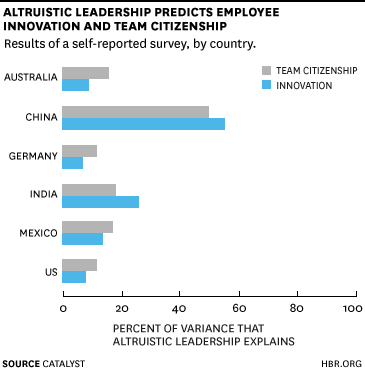
A recent Catalyst study backs this up, showing that humility is one of four critical leadership factors for creating an environment where employees from different demographic backgrounds feel included. In a survey of more than 1500 workers from Australia, China, Germany, India, Mexico, and the U.S., we found that when employees observed altruistic or selfless behavior in their managers — a style characterized by 1) acts of humility, such as learning from criticism and admitting mistakes); 2) empowering followers to learn and develop; 3) acts of courage, such as taking personal risks for the greater good; and 4) holding employees responsible for results — they were more likely to report feeling included in their work teams. This was true for both women and men.
Employees who perceived altruistic behavior from their managers also reported being more innovative, suggesting new product ideas and ways of doing work better. Moreover, they were more likely to report engaging in team citizenship behavior, going beyond the call of duty, picking up the slack for an absent colleague — all indirect effects of feeling more included in their work groups.


Our research was also able to isolate the combination of two separate, underlying sentiments that make employees feel included: uniqueness and belongingness. Employees feel unique when they are recognized for the distinct talents and skills they bring to their teams; they feel they belong when they share important commonalities with co-workers.
It’s tricky for leaders to get this balance right, and emphasizing uniqueness too much can diminish employees’ sense of belonging. However, we found that altruism is one of the key attributes of leaders who can coax this balance out of their employees, almost across the board.


Nonetheless, our study raises one common, perhaps universal implication: To promote inclusion and reap its rewards, leaders should embrace a selfless leadership style. Here are some concrete ways to get started based on both our current research and our ongoing study of leadership development practices at one company, Rockwell Automation:
  • Share your mistakes as teachable moments. When leaders showcase their own personal growth, they legitimize the growth and learning of others; by admitting to their own imperfections, they make it okay for others to be fallible, too. We also tend to connect with people who share their imperfections and foibles—they appear more “human,” more like us. Particularly in diverse workgroups, displays of humility may help to remind group members of their common humanity and shared objectives.
  • Engage in dialogue, not debates. Another way to practice humility is to truly engage with different points of view. Too often leaders are focused on swaying others and “winning” arguments. When people debate in this way, they become so focused on proving the validity of their own views that they miss out on the opportunity to learn about other points of view. Inclusive leaders are humble enough to suspend their own agendas and beliefs In so doing, they not only enhance their own learning but they validate followers’ unique perspectives.
  • Embrace uncertainty. Ambiguity and uncertainty are par for the course in today’s business environment. So why not embrace them? When leaders humbly admit that they don’t have all the answers, they create space for others to step forward and offer solutions. They also engender a sense of interdependence. Followers understand that the best bet is to rely on each other to work through complex, ill-defined problems.
  • Role model being a “follower.” Inclusive leaders empower others to lead.  By reversing roles, leaders not only facilitate employees’ development but they model the act of taking a different perspective, something that is so critical to working effectively in diverse teams.
At Rockwell Automation, a leading provider of manufacturing automation, control, and information solutions, practicing humility in these ways has been essential to promoting an inclusive culture — a culture Rockwell’s leaders see as critical to leveraging the diversity of its global workforce.
One of the key strategies they’ve adopted to model this leadership style is the fishbowl — a method for facilitating dialogue.  At a typical fishbowl gathering, a small group of employees and leaders sit in circle at the center of the room, while a larger group of employees are seated around the perimeter.   Employees are encouraged to engage with each other and leaders on any topic and are invited into the innermost circle.  In these unscripted conversations, held throughout the year in a variety of venues, leaders routinely demonstrate humility —by admitting to employees that don’t have all the answers and by sharing their own personal journeys of growth and development.
At one fishbowl session, shortly after the company introduced same-sex partner benefits in 2007, a devoutly religious employee expressed concerns about the new benefits policy — in front of hundreds of other employees.  Rather than going on the defensive, a senior leader skillfully engaged that employee in dialogue, asking him questions and probing to understand his perspectives.  By responding in this way, the leader validated the perspectives of that employee and others who shared his views.   Other leaders shared their own dilemmas and approaches to holding firm to their own religious beliefs yet embracing the company’s values of treating all employees fairly.   Dialogues such as these have made a palpable difference at Rockwell Automation.  Employees have higher confidence in their leaders, are more engaged, and feel more included — despite their differences.
As the Rockwell example suggests, a selfless leader should not be mistaken for a weak one. It takes tremendous courage to practice humility in the ways described above. Yet regrettably, this sort of courage isn’t always rewarded in organizations. Rather than selecting those who excel as self-promotion, as is often the case, more organizations would be wise to follow the lead of companies like Google, Rockwell Automation, and others that are re-imagining what effective leadership looks like.
More blog posts by  and 
80-jeanine_prime

As the leader of the Catalyst Research Center for Advancing Leader Effectiveness,Jeanine Prime, PhD, leads studies on leadership, change management, and organizational effectiveness. Currently, she spearheads Catalyst’s research and programs on engaging men in gender equity initiatives.
80-elizabeth_salib

As a senior research associate at Catalyst, Elizabeth Salib, PhD, works to develop inclusion in the middle layers of an organization by researching how leaders and men in particular can foster inclusion on a work team.