MAIN SOURCES

MAIN SOURCES

Monday, September 1, 2014

From a tourist goose on the Thames to a blue shark in Cornish waters... The beautiful award-winning photographs from this year's British Wildlife Photography Awards

Urban Wildlife winner: Lee Acaster’s ‘The Tourist’, greylag goose, London, England. Photograph: Lee Acaster/PA

WildPix Young People’s award (12-18) winner: 16-year-old Joshua Burch’s ‘On the Prowl’, fox, south London, England. Photograph: Joshua Burch/BWPA

Animals Portraits category winner: Steven Fairbrother’s ‘Shag Resting’, Northumberland.Photograph: Steven Fairbrother/PA

Habitat winner: Ruth Asher’s ‘A life at Sea’, nesting gannets, Shetland Isles, Scotland. Photograph: Ruth Asher/BWPA

British Seasons winner: Andrew Parkinson’s ‘Hares’, Derbyshire, England. Photograph: Andrew Parkinson/BWPA

Wild Woods winner: Peter Cairns’ ‘Autumn Jewels’, Woodland, Cairngorms, Scotland. Photograph: Peter Cairns/BWPA/Northshot

Close to Nature category winner: Jim Greenfield’s ‘Grey Seal Claw’, Lincolnshire. Photograph: Jim Greenfield/PA

Animal Behaviour winner: Richard Shucksmith’s ‘Otter and Puffin’, Shetland Isles, Scotland.Photograph: Richard Shucksmith/BWPA

Coast and Marine winner: Alexander Mustard’s ‘Big Blues’, blue sharks, Cornwall, England.Photograph: Alexander Mustard/BWPA

Hidden Britain category winner: Susie Hewitt’s ‘Window Gnat’ taken in County Antrim. Photograph: Susie Hewitt/BWPA

Under 12 Young People category, a dipper with grubs taken in Dumfries by William Bowcutt.Photograph: William Bowcutt/PA

British Nature in Black and White category winner: Alexander Mustard’s ‘Blue on Black’, a blue shark in Cornwall. Photograph: Alexander Mustard/BWPA

Botanical Britain category winner: ‘Green and Red Telephone Box’, covered in ivy taken in London by Philip Braude. Photograph: Philip Braude/BWPA

School Award winner: Michael Drayton Photograph: Michael Drayton /BWPA

Red Deer Stags Enduring Blizzard by Margaret Walker, winner of the Habitat category

Fallow Deer on Housing Estate by Jamie Hall, winner of the Urban Wildlife category

Winter in the Ptarmigan series by Tomasz Garbacz, winner of the British Seasons award

Autumn in the Ptarmigan series by Tomasz Garbacz, winner of the British Seasons award

30 photos that will make you want to fly to Australia right now. http://read.bi/1nOB0Fp (Image: Robert Schrader/Leave Your Daily Hell)


I initially hatched the idea to take a trip to Australia back in 1992, thanks to my eccentric second-grade teacher. Mrs. Fraley designed our entire school year around her love of The Land Down under, from science units on the life cycles of marsupials, to traditional folklore myths and songs, to geography lessons about the Outback and what was known, at the time, as Ayer’s Rock. (She even took us to Outback Steakhouse, although I now know that place is anything but Australian!)
On account of being seven (and very middle-class) at the time, it took me exactly 20 years to take my first trip to Australia, where I saw koalas and kangaroos up-close, traipsed through the red sands of the Outback, ate real Australian food and hummed along to “Waltzing Matilda” the first time I heard it. I’m eager to return to Australia to cover the vast amounts of the country I missed during the six weeks I spent there, but for now, use my pictures are inspiration to plan your own trip to Australia.

1 The skyline of Melbourne, Australia:


   2 The boundary between nature and civilization in Austral is often blurred:


3 Melbourne's Flinders Street station at night:


4 A colorful scene in Melbourne's Fitzroy district:


5 A bird perched on a tourist:


6 A koala along the Great Ocean Road, near Melbourne:


7 The Seven Apostles, the highlight of the Great Ocean Road:


8 The Sydney Harbour Bridge:


9 One of Sydney's lesser-known landmarks is this massive Coca-Cola sign:


11 The Sydney skyline as seen from way across its harbor:


12 A seagull on Sydney's Bondi Beach:


13 Mary Poppins comes to Sydney:


14 A crowded Bondi Beach afternoon:


15 The Australian outback:


16 A beautiful flourish of color in the arid outback:


17 A wide view of Kata Tjuta, a rock formation in the Australian outback:


18 An outback hare:


19 Sunset in Australia's Red Center:


20 Coffs Harbour, New South Wales:


21 Where the rainforest meets the sky:


22 Pink cockatoos in Coffs Harbour:


23 Seven-Mile Beach in Byron Bay:


24 Sunset in Rainbow Beach, Queensland:


25 Downtown Brisbane:


26 Rock wallabies on Magnetic Island:


27 The only snake I saw in Australia:


28 One of Queensland's big, beautiful trees:


29 A dramatic downward scattering of birds in the outback:


30 A kangaroo on the beach in Coffs Harbour:


Sunset over Kata Tjuta:



Turns Out You've Been Brainstorming All Wrong

JUDITH E. GLASER
CEO, Benchmark Communications
Suppose you’re invited to participate in a brainstorming session. The facilitator says that “every idea counts” and invites you to propose as many ideas as you can in the next 15 minutes. You feel rushed. You suppress ideas you think won’t get support. You narrow your own limited list of ideas, offering just a sample to the group. The facilitator posts yours and your colleagues’ ideas, inviting everyone to vote for which is best. Of course, not everyone is on board with the winning idea and while some give in, most aren’t sure about the new direction the meeting has taken.
Therein lies the rub. Our tried-and-true ideation processes can actually dampen the creativity companies are working so hard to create. To promote real innovation, we need to stop giving lip service to new thinking, get away from the need to reach consensus and instead nurture approaches that truly forge new ground.
The resistance to change and real innovation is natural. It’s driven by some deep-seated forces that we need to recognize to foster new thinking.
  • Force #1: Need for inclusion and connection: When we are brainstorming with others, the need to agree, feel included and to think the same way others do. Real innovation requires divergence and expanding our ideas into the far recesses of our brain that may be less comfortable or familiar.
  • Force #2: Being Right: Thinking the same thoughts repeatedly lulls us into a sense of comfort. Thinking we know the “correct” answer reinforces feelings of intelligence and good judgment. We may not even realize we are in a repetitive loop, or experiencing status quo thinking. Instead, we feel good that we got it right.
  • Force #3: Mental Grooves: Thinking repetitive thoughts etches “grooves” into the brain. The brain then reinforces what it knows, perhaps at the expense of what is new and novel. Along these well-trodden paths, brain structure serves to link learning to behavior in predictable ways. Yet getting into those parts of the brain forges new connections—both at the idea level and at the level of the brain tissue itself.
To up our innovation game we have to think differently. We rarely pay enough attention to leveraging our capacity to form new ideas, test, refine, and advocate for new concepts. Here are some tips to do just that:
Tip 1: Prime your brain with trigger wordsWe need to prime our brains to freely generate and express ideas, not suppress them. So, state the problem or challenge you are working on. Find trigger words related to your challenge to get your juices flowing. Sleep on it, watch a movie, and go to a park. Give the body something to do while the mind wanders freely. Then put yourself to work.
If you’re in a group, consider listing trigger words in two columns on a white board and asking colleagues to look for connections between the words that otherwise wouldn’t be obvious. Invite people to generate as many ideas as they can for a few minutes, and then conduct your brainstorming session with your brains primed to think differently.
Tip 2: Think of the worst idea. Remove the fear of making mistakes, feeling stupid or safe or receiving negative feedback. No idea is a bad idea. In fact, research shows that what appears after ‘the worst idea’ can become a trigger for the best ideas no one has thought of before.
Tip 3: Let it flow. Don’t wait for inspiration or settle for perfect solutions. Instead, generate a wealth of ideas with others. When you’re inclined to stop, or judge your ideas, keep going. Don’t get caught in your usual patterns and instead open up your mind to a ‘non-judgmental’ state where your ideas and others’ ideas can connect. If you are feeling anxious, uncomfortable, or lost in uncharted territory, know you are on the right track.
Remember: Most innovative ideas come through experimentation and discovery. Prime your brain and set the stage for the most amazing new novel and exciting ideas to emerge. In the process you’ll learn to learn to trust innovation instincts – yours and everyone else’s.

Sunday, August 31, 2014

11 Books By CEOs That Will Teach You How To Run The World. Business Insider

Sophia Amoruso, founder of Nasty Gal and author of "#GIRLBOSS."
Business books are notorious for being loaded with MBA lard, trotting out "key takeaways" like "take risks," "build a great team," and "don't be afraid to fail." 
But the ones worth reading ditch the platitudes in favor of instructive anecdotes — which is why they so often come from execs who have lived through it. 
From fashion startups to automotive empires, here are the best leadership books from people who have led their companies to success.


Scroll down to see the books


"The Hard Thing About Hard Things"


What is the hard thing about hard things? That they don't have a formula, says Ben Horowitz.

"Hard things are hard because there are no easy answers or recipes," he writes. "They are hard because your emotions are at odds with your logic. They are hard because you don’t know the answer and you cannot ask for help without showing weakness." 
Horowitz, now one of the most sought-after investors in the game, used to be CEO of software management company Opsware before it was acquired by HP for $1.6 billion. 
Bonus: Horowitz shows off his ridiculously extensive knowledge of rap lyrics — quoting Kanye West and DMX before the close of the opening chapter. 

Buy it here >>


"My Years with General Motors"


Alfred Sloan was the CEO of General Motors from 1923 to 1946 — when the car company was arguably the most important organization on Earth. 
More than your average business memoir, the book is a distillation of Sloan's experiences and thoughts around how to steer a massive organization. It serves as a treatise on decentralization and the structure of the modern corporation. 

Buy it here >>


"Rework"


Coauthored by Jason Fried, the cofounder and CEO of Basecamp, "Rework" is a spare startup manifesto. 

While everything in the book might not apply to you — Fried's company has remained at a tiny 37 members while staying profitable — it's useful for the contrarian mirror it provides. After reading it, you'll scrutinize every meeting request that crosses your desk. 

Buy it here >>


"Let My People Go Surfing: The Education of a Reluctant Businessman"


Patagonia founder and CEO Yvon Chouinard is rightly known for keeping it real.

"No young kid growing up ever dreams of someday becoming a businessman," the outdoors mogul begins his memoir. "He wants to be a fireman, a sponsored athlete, or a forest ranger. The Lee Iacoccas, Donald Trumps, and Jack Welches of the business world are heroes to no one except other businessmen with similar values. I wanted to be a fur trapper when I grew up." 
As an executive, Chouinard kept that adventurous ethos at the core of the company, whether by making sustainable supply chains or encouraging his employees to — yes — go surfing in the middle of the day. 

Buy it here >>


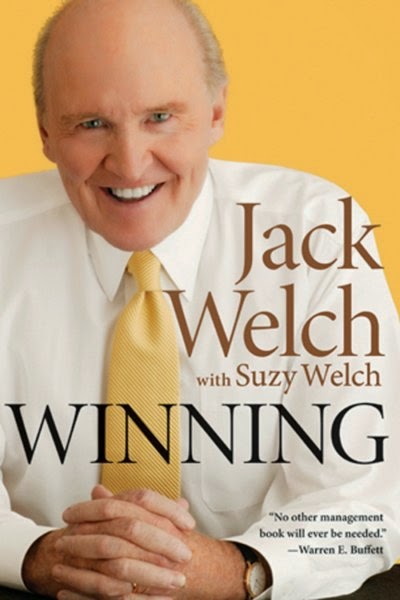
"Winning: The Ultimate Business How-To Book"


Jack Welch ruled General Electric from 1981 to 2001. 

Welch shared the history of the experience in his "Jack: Straight From the Gut." But his follow-up book "Winning" makes the list because it reveals Welch's approach to management and careers, from dealing with a bad boss to landing promotions to executive decision making. 

Buy it here >>


"#GIRLBOSS"


Sophia Amoruso grew online fashion retailer Nasty Gal into a $100 million business.
In "#GIRLBOSS," Amoruso — who started her business selling clothes on eBay — takes a delightfully flippant view on building a career.
Discussing her life before Nasty Gal, she writes: 
What all of these jobs taught me is that you have to be willing to tolerate some shit you don't like — at least for a while. This is what my parents' generation would call 'character building,' but I prefer to call it '#GIRLBOSS training.' I didn't expect to love any of these jobs, but I learned a lot because I worked hard and grew to love things about them.
Awesome, right?

Buy it here >>


"Business @ the Speed of Thought: Succeeding in the Digital Economy"


Bill Gates' 1999 book nailed the essence of data-based decision-making before "data science" was even a thing. 
"The most meaningful way to differentiate your company from your competition, the best way to put distance between you and the crowd, is to do an outstanding job with information," he writes. "How you gather, manage, and use information will determine whether you win or lose." 
The book is also compelling for its historical value. The year the book was published, Gates' company set the record for market capitalization at a cool $618.9 billion

Buy it here >>


"Pour Your Heart into It : How Starbucks Built a Company One Cup at a Time"


Howard Schultz — now worth $2.2 billion — changed the world with Starbucks, a company that made cafe culture endlessly accessible. 

He unpacks he method in his 1999 memoir.
"People want guidance, not rhetoric," Schultz writes. "They need to know what the plan of action is, and how it will be implemented. They want to be given responsibility to help solve the problem and authority to act on it." 

Buy it here >>


"Delivering Happiness: A Path To Profits, Passion, And Purpose"


Zappos CEO Tony Hsieh's "Delivering Happiness" — which has become a brand unto itself — is remarkable for the way it marries airy startup visions with pragmatic business knowhow. 

Consider this selection
My advice is to stop trying to 'network' in the traditional business sense, and instead just try to build up the number and depth of your friendships, where the friendship itself is its own reward. The more diverse your set of friendships are, the more likely you'll derive both personal and business benefits from your friendship later down the road. You won't know exactly what those benefits will be, but if your friendships are genuine, those benefits will magically appear 2-3 years later down the road.

Buy it here >>


"Raising the Bar: Integrity and Passion in Life and Business: The Story of Clif Bar & Co."
Adventure sports snack brand Clif Bar was nearly sold by founder Gary Erickson, but he instead bought out his company to keep the company private and solely owned. 
This put the company into a precarious — but fruitful — position. He writes
Clif Bar Inc. made itself vulnerable by staying private. I think people appreciate Clif’s vulnerability and that’s why they help us on our journey. People find the best flavors and finest ingredients for us. Others go out of their way to secure the best packaging deals possible. Consumers send us information on sustainability. They know we are not a large entity just trying to make money.
Beyond the usual how-we-did-it narrative, the Clif Bar tale is fantastic for the way it shows how a brand can communicate with its users at a surprisingly personal level, as numerous anecdotes show. 


"Setting the Table: The Transforming Power of Hospitality in Business"


Danny Meyer has been called the "restaurateur of his generation."

As CEO of the Union Square Hospitality Group, Meyer has made New York his culinary domain, with the classy Union Square Cafe, the legendary Gramercy Tavern, and the perpetually queued Shake Shack all under his stead, among others
In "Setting the Table," the exec sets out his philosophy of "enlightened hospitality." 
"Service is the technical delivery of a product," he writes. "Hospitality is how the delivery of that product makes its recipient feel."

Buy it here >>


And if you don't have much time to read:

25 Business Books Summarized In Once Sentence Each >>